I Built My Own Financial Controller in an Afternoon
I want to show you something I built, and then I want to ruin your week with three questions about it.
The thing I built is simple to describe: a personal finance dashboard that runs itself. Every week it tells me where my money went, flags anything weird, tracks whether I'm on pace for my savings goal, and drops a clean summary into my inbox.
No financial adviser. No fintech app with a monthly fee. No spreadsheet I have to remember to update and then resent.
One person. One afternoon. A tool called n8n.
Let me show you the exacts — because the build is the whole point, and the moment you see how few moving parts there are, the questions at the end stop feeling theoretical.
The build, step by step
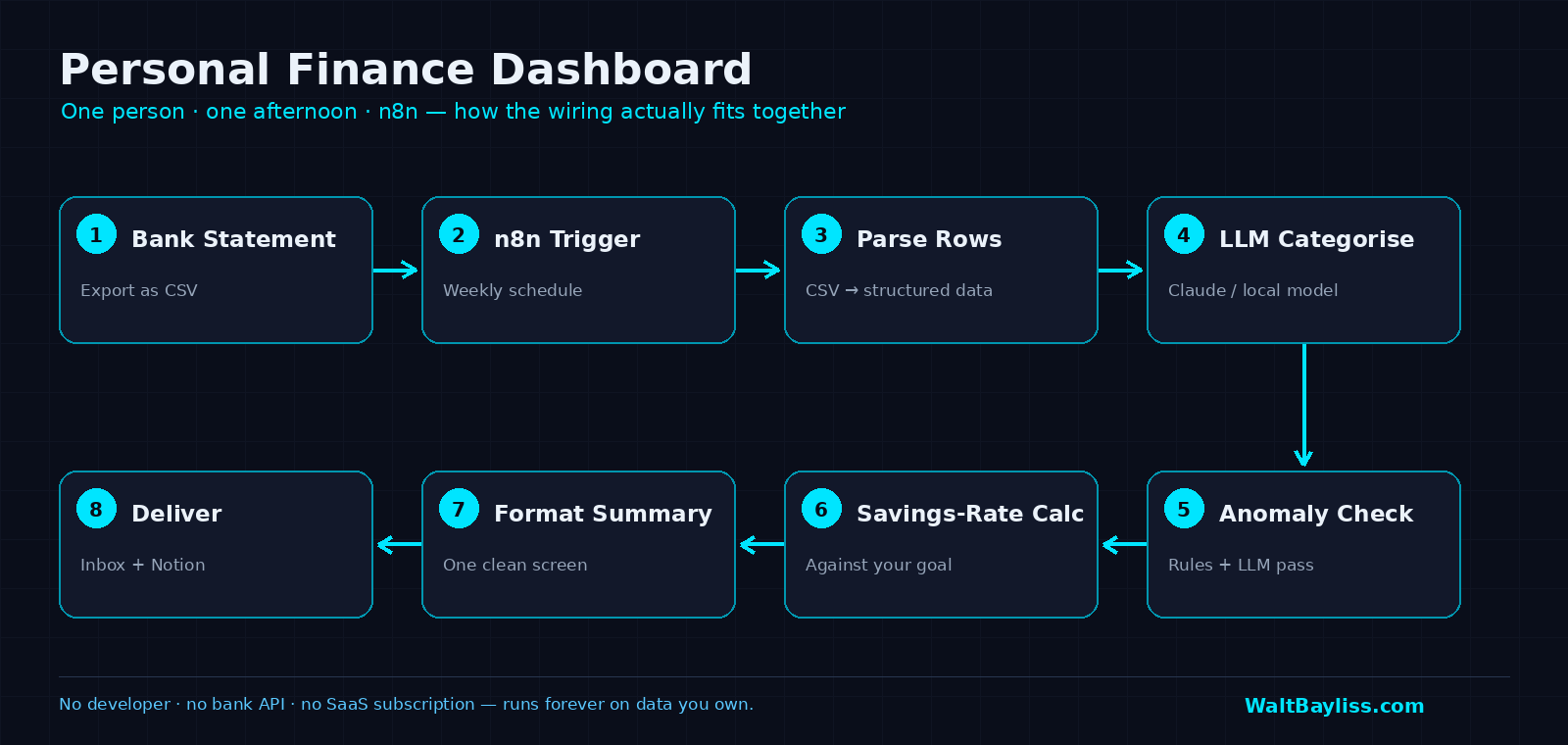
Here's the data flow. Read it once and you'll see there's no magic in it.
[FLOW CHART: Bank statement export (CSV) -> n8n trigger -> Parse rows -> LLM categorisation node (Claude / local model) -> Anomaly check (rules + LLM) -> Savings-rate calculation against goal -> Format summary -> Deliver to inbox + Notion]
Now the same thing in plain English, node by node.
1. The trigger. n8n runs the whole thing on a schedule — once a week, say, Sunday night. You can also kick it off manually. That's the heartbeat.
2. The input. Your bank lets you export a statement as a CSV. Every bank does. That file is the raw material — every transaction, date, amount, description. You drop it in a folder, or email it to a watched inbox, and n8n picks it up.
3. Parse the rows. n8n reads the CSV and turns each line into structured data it can work with. Nothing clever yet — just tidying.
4. Categorise with an LLM. Here's where it gets interesting. Each transaction gets passed to a language model — Claude via the API, or a local model running on your own machine if you'd rather nothing leaves the house. The model reads "WLMT 4471 GROCERY" and knows that's groceries. It reads the messy, abbreviated, human nonsense your bank prints and sorts it into clean categories. The thing a bookkeeper does by eye, in seconds, for free.
5. Anomaly check. A mix of simple rules and a second LLM pass. Did a category spike? Did a subscription you forgot about renew? Did a number show up that doesn't fit your pattern? It flags it. This is the bit that actually earns its keep — it's the stuff you'd never catch scrolling your banking app at a red light.
6. Savings-rate calculation. You've told it your goal. It does the maths: here's what came in, here's what went out, here's your savings rate, here's whether you're ahead or behind the line. No emotion. No "I'll start next month." Just the number.
7. Format the summary. A clean, readable briefing. Top spending categories. Anything flagged. Your savings rate versus goal. One screen.
8. Deliver. Into your inbox. Or your Notion. Or both. Sunday night, it's just there.
That's it. That's the whole machine.
The part that should make your eyebrows go up isn't any single step. It's that not one of these steps needs a developer, a bank's permission, or a SaaS subscription. n8n plus a model you can rent for cents or run for free. An afternoon of wiring. And then it runs forever, for you, on data you own.
People assume this kind of thing requires a fintech company to build it and sell it back to them. It doesn't. It requires one curious person and a free Sunday.
Now the three questions I can't shake
Here's where I ruin your week.
Question one. If a single person can do this for themselves — what happens when you point it at a business?
Because the only real difference between my personal dashboard and a company's finance function is scale and connection. Same shape. Bank feeds in. Categorisation. Anomaly detection. Reporting against targets. A business just has more accounts, more rules, and bigger systems to plug into — accounting software, payroll, invoicing, the lot.
But "bigger systems" is exactly what tools like n8n connect. So if I can wire my own statement into an automated weekly briefing in an afternoon, what stops the same pattern — built properly, connected to the real systems — from running a company's entire financial reporting cycle?
Nothing I can see. And that leads straight to the uncomfortable one.
Question two. Does this put the work of financial controllers at risk?
I'm not going to dodge it. A lot of what a financial controller does day to day — categorise, reconcile, flag the anomaly, produce the weekly and monthly report — is exactly the work this machine does. And by the rule I keep coming back to: if a computer can do it, it's about to be done by AI, and done well.
But here's the part the scary version of this question leaves out. The reporting is the automatable bit. The judgement isn't. Knowing what the anomaly means. Deciding what to do about it. Sitting across from a board and reading the room. Choosing which fire to put out first.
So no — I don't think the controller disappears. I think the part of the job that was clicking and reconciling gets handed to the machine, and the part that's actual judgement becomes the entire job. That's not a smaller role. For the right person, it's a bigger one. The desk gets cleared so they can finally do the work that needed a human all along.
The risk isn't to financial controllers. It's to anyone — in any role — who decided their value was the clicking.
Question three, and this is the one for the entrepreneurs reading.
Could you build this on a platform, demo it to a company, and get them to pay you for it?
Sit with that. Because the honest answer is yes — and it's closer than you think.
You just watched me describe a system any business with a finance function would genuinely want. You don't need to invent anything. You need to build the thing I described, connect it to the systems a real business runs, make it reliable, and walk into a meeting with a working demo instead of a pitch deck.
That's a product. That's a service. That's a business — and it didn't exist as something one person could realistically deliver until about ten minutes ago.
This is the opportunity I keep banging on about. We're sitting in a tiny bubble of people who know this is possible. There are hundreds of millions of business owners who have no idea — and who don't want to learn n8n. They want the outcome. The weekly briefing. The anomaly caught. The clean number.
Someone's going to build it for them and get paid handsomely for the outcome.
Why not you?
I built mine in an afternoon to manage my own money. The build was the easy part. The hard part is what I keep circling back to: once you've seen how few moving parts it takes, you can't un-see where it points.
So I'll leave you with the same three questions, in order. Could it be done for a business? Almost certainly. Is some work at risk? The clicking is — the judgement isn't. And could you be the one who builds it and gets paid?
That last one's not rhetorical. Have a think about it this week.
— Source: Daily Brief 2026-05-22 — AI Ideas #3. Walt instruction: write as a blog post + Facebook post; outline the exacts, show how it's put together (flow chart), then ask the three escalating questions incl. the entrepreneur angle.


